Artsfest is one of our very favorite events. Extremely well run, great crowds, great customers, phenomenal volunteers and staff, beautiful venue, great area. Setup is uncomplicated, although you may have to dolly a ways if you are on the 'wooded path', but they have big 4 wheel dollies to use, and if you have a disability, they are on the spot with golf carts to tote your stuff. Break down is smooth, and you can set up a day early and break down on Monday if you prefer. I guess some folks don't like the booth fee - $50 plus 14%, but they earn every penny. Constant crowds, great 'shoes' and lots and lots and lots of bags full of purchases. Out of 166 booths (no doubles) I did find ONE buy/sell- Hudson River Inlay. Beautiful stuff but I am pretty sure if the guy working the booth has ever touched a piece of wood it was a pencil. Tough show to get into, but very worthwhile. Many Thanks to Melissa and her fantastic team!
All Posts (7768)
Sort by
November 6-8 
Melbourne, Florida
Presented by: Melbourne Main Street
200 Artists
Deadline: October 8
Application Fee: $32
Booth Fee: $265
The 22nd annual Fall Art Festival takes place in historic downtown Melbourne and features over 200 artists. Featuring nationally recognized bands over the three day weekend, this event is currently the largest free admittance art festival and concert series in all of Central Florida.
For this yearly event, we close down roughly 5 blocks of East New Haven Avenue (also known as Main Street) in Melbourne and its side streets and open it up to artists to sell and interact with the public. The Fall Festival typically brings in between 30,000-40,000 visitors of the 3 day event. Located on Florida's Space Coast, we are just two miles from the beach and a short drive to Orlando.

This year we will be featuring a live art tent allowing artists to showcase their skills and the evolution of an idea. This feature will provide an elevated level of exposure and networking opportunities between artists and the community.
Marketing:
Promotion of the event to the art-buying public in television commercials, newspapers, radio, direct mail, press releases, billboards, magazines, and social media valued at over $35,000.
Learn more: www.melbournefallartfestival.com/
Contact: Lacey Zimmerman
Email: melbournefallartfestival@gmail.com
Phone: (321)724-1741
~~~~~~~~~~~~~~~~~~~~~~~
Find more art fairs that will welcome you: www.CallsforArtists.com
Hi, finally got some used propanels down here in FL, "Happy girl", how do you transport your panels to your booth, do you buy the propanel cart or what, needing ideas that might save $$ but easy to use. Thanks, Jackie
This is my second time doing this show, first time blogging on AFI. It was my single best show in a still short art festival career. (I started exhibiting in art fairs in 2014.) Crowds were great with art savvy patrons. The weather cooperated. Alexandria, VA is a vibrant, fun, urban spot on the shores of the Potomac close to DC. 200 artist booths form a line (almost all back to back facing the sidewalk) the length of King Street from Union to Washington Streets in Old Town Alexandria.
Show Hours: Saturday, 10am to 7pm; Sunday, 10am to 5pm. Free and open to the public.
Load In: Saturday morning in the wee hours. Artists can drive to their spots to unload after 3:30am but cannot start setting up until 5:30am when all vehicles have to be moved from the street. Booths should be open for business by 9:30am although the show officially opens at 10am. A new policy -- restricting the booth setup start time to after 5:30am helped in getting an extra, much-needed hour's sleep. (I unloaded at 4:30am and could have done so a little later.)
Load Out: No sales are allowed after 5:30pm. Artists break down their booths and when all tents on the block are down, they are given the okay to drive in to load out. I was staying at the Monaco Hotel ... and parked there so chose to dolly out. Some very quick neighbors were out of there around 6pm, heading home. Most, more like 6:30-7pm.
Amenities: Pastries, bagels, coffee, juice and fresh fruit + waters provided each day. The Monaco Hotel right there on King Street is wonderful. Plenty of great restaurants and shops in the area so lots of options to choose from for lunches, snacks although not too many quick ones. There are no booth sitters. You'll have to rely on your own "help" or your neighbors for a break.
Artist Mix: I never get the opportunity to walk much of the show myself but what I saw looked to be high quality, interesting art in a range of styles, presented well.
Price Point/Sales: As mentioned earlier, this show tops the list in sales for me. Purchases were made at the mid to top of my price range to happy, new (to me) collectors. I saw few people walking around with multiple purchases -- but did see some large work passing by. In the case of my collectors, the painting(s) they bought from me were their sole purchases (that I know of) that weekend. My best day -- by far -- was on Saturday. Two more paintings were purchased on Sunday but there seemed to be less buying energy that day -- in my booth, anyway.
Booth Layout: Booths run down the center of King Street, almost all back-to-back down the center line, opening to the sidewalk. There are some booths that are singles, opening to either side. Spaces are approximately 11 - 12 feet wide, so with some cooperation with your neighbors, there may be a little extra room between you for storage. With this single-street layout, all booths are good ones and the back-to-back arrangement means it is easier for people walking the show to see each one. Booth assignment/numbers are available the Thursday before the show -- but numbers are not posted so it takes some good communication to your potential visitors with the inclusion of cross streets and landmarks to get them to you. (I had at least one visitor mentioning that he wished he'd read the "fine print" on my email.)
Atmosphere: Perfect for producing a crowd concentrating on the art. No music, acts, activities, food booths, face painting, balloons. Any visitors interested in dining, drinks, other shopping had plenty of great options in the establishments there on King Street. Large, steady, art-savvy crowds. Lots of dogs.
Staff: This is a Howard Alan produced event. There aren't any volunteers, but there is a professional, capable staff on hand all weekend. There is no hand-holding involved. No check-in other than to show up at your booth at the appropriate time. Communication is clear and sparse.
Tips If Doing the Show: Because booth numbers are not evident, let potential visitors know your location by using cross street or landmarks near your booth. Parking is tough in Alexandria for show visitors and artists. I have a small vehicle by art show standards and stayed put at the Monaco Hotel.
Other Comments: My success at this show was at least partially influenced by name recognition and reputation in Alexandria. I'm a long-time member and frequent exhibitor at the Art League in the Torpedo Factory and two of my purchasers were already familiar with and drawn to my art. An artist neighbor indicated that very fine painters she knew did not do so well at the show. My immediate neighbors -- a jeweler and wood-turner did have a good weekend.
Yes, I would definitely return!
January 23

Waukesha, Wisconsin
Presented by: ArtWorks Wisconsin
80 Artists
Deadline: October 1
Application Fee: $10
Booth Fee: $115
 If you have been doing Art Shows for a few years, you know how you end up with items which don't make it to your shows any longer.
- You are sick of looking at them
- you didn't like how it turned out
- it got damaged.
- Whatever the reason, the piece sits in the corner of your studio collecting dust.
Bring those items to ArtWorks: Wisconsin, mark the price down and move it out! All we ask is a section of your booth be "on sale". You don't have to mark everything down, but attendees are looking for deals. This one-day show is quick and easy. In and out! What else do you have to do in January? Join us!
Learn more & apply: www.artworkswisconsin.com
Contact Person: Colin Murray
Email: colin@artworksmadison.com
Phone: (608)712-3440
Hello;
I am new at this, and have a question. I am in the process of purchasing a tent for my shows, and notice that display panels come in both mesh and fabric backing. Which one is better for hanging artwork (stretched framed canvas') and HOW do you attache the art to the panels? Thanks
I can't seem to find any information on this show, and was wondering if it would be worth while.
If anyone has input, it would be much appreciated!
thanks
For the upcoming Atalaya Arts and Crafts Festival in Murrells Inlet, SC, AccuWeather is predicting over 4” total rain on Thursday (setup day) and Friday (setup / opening day), with showers lasting 17 hours on Thursday (with winds of 20-32 mph) and 20 hours on Friday due to an Atlantic storm coming onshore around Myrtle Beach that was thought to have “tropical characteristics” a few days ago.

Fortunately, we will not be participating this year. I was wondering what/how other participants are doing as the storm progresses:
- Anyone canceling?
- Reports from the front line?
- Any flooding of the castle?
 March 3-6
La Quinta, California
Presented by La Quinta Arts Foundation
220 artists
220 artists
Deadline: September 30
Application Fee: $50
Booth Fee: $275 single booth
 La Quinta Arts Festival is held on the spectacular grounds of the La Quinta Civic Center Campus, a life-size picture postcard framed by majestic mountains, lush green lawns, and a lake. La Quinta Arts Festival is ranked #1 Fine Art Festival in the Nation by Art Fair SourceBook 2013, 2014, 2015 and #1 Fine Art & Design Show by Sunshine Artist 2014.
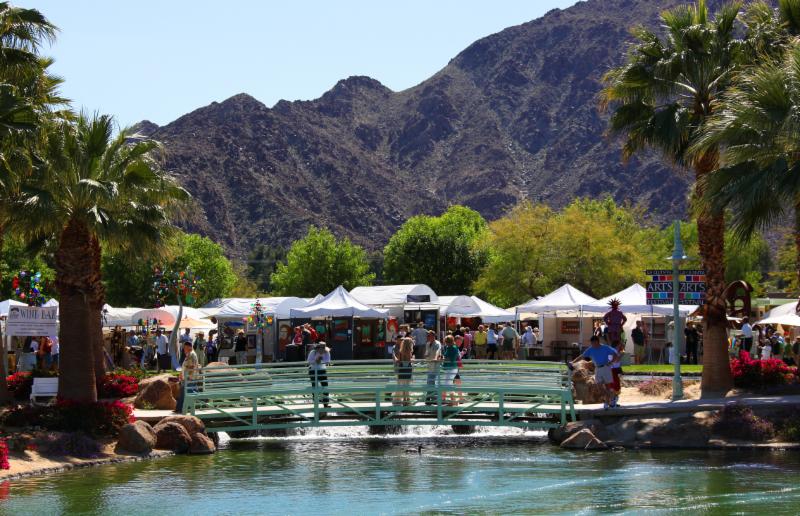
Hosting 220 of the nation's foremost contemporary artists, the four day show attracts an affluent demographic and wealthy snowbirds who have second homes in the southern California desert. The festival runs concurrent with the HITS Horse Show which attracts the most accomplished equestrian riders in the world and is the weekend before the BNP Tennis Open March 8-21.
Artists pay a show fee of 20% of all art sales made at, or as a result of participation in La Quinta Arts Festival. A low booth fee of $275 for a 12'x12' space means minimal up-front investment to participate, and allows LQAF to be successful only if the artists are successful.
Marketing:
La Quinta Arts Festival prides itself on the comprehensive marketing plan which brings an average of 23,000 high qualified art partons to festival each year. We utilize print, television, radio media as well as direct mail to targeted zipcodes, billboards, and social media. Goal is always to reach the "right" patron and never the mass market.
Noteworthy:
- Gross Art Sales in 2014 & 2015
 averaged $3 million each year
 - Average Art Sales per artist in 2014 & 2015 was over $13,000
- Dedicated 24/7 Artist Hotline-contact booth sitters by cell phone
- 24 hour Private security and Police
- Leisurely 2 day set-up and tear-down. Paid Labor Assistance with flatbed golf carts available
- Artist Hospitality includes morning and afternoon snacks, chilled bottled water throughout the day, a gourmet lunch box delivered daily to each booth (Artist selects lunch order)
- Impressive Artist Award Reception
- Booth Fees from $275-$775-all booths located on lush grass
- Year round exposure to art buyers on LQAF.com Artist Galleries, $100 annual fee
Apply: www.Zapplication.org
Website: www.LQAF.com or call or email our dedicated artist helpline:
760-564-1244 ext. 112 or helpline@LQAF.com
Contact: Kathleen Hughes, Kathleen@LQAF.com, (760)564-1244
~~~~~~~~~~~~~~~~~
Find more shows looking for you right here: CallsforArtists.com
March 18, 19 & 20
Winter Park, Florida
Central Park along Park Avenue
225 Artists
Deadline: September 25
The 57th Annual Winter Park Sidewalk Art Festival is one of the nation's oldest and most prestigious juried fine art shows. It consistently ranks among the most highly regarded outdoor art shows in the nation as artists compete for one of the largest cash awards ($72,500) among the top shows.
Along with cash awards our enthusiastic Patrons Program is expected to spend more than $60,000 in Patron Bucks this year. The show is conveniently located in Central Park, a beautifully landscaped area whose surrounding streets are closed during the festival to allow for foot traffic only.

Artists' booths nestle under large oak trees in the park and line Winter Park's Park Avenue, the heart of a charming downtown with brick streets, unique boutique shops, and inviting outdoor cafes and bistros. Attendance usually reaches 350,000 people for the three-day event.
Highlights:
- Ranks #5 in the nation and #1 in the southeast bySunshine Artist magazine in their 2015 list of Best 200 Fine Art and Design Shows
- Ranks #1 in Art Fair Calendar's 2014 America's Best Art Fairs survey
- Presents $72,500 in 63 cash awards including a $10,000 Best of show purchase award, a $5,000 Art of Philanthropy Award purchase award and a $2,500 Award for a Distinguished Work of Art given by the Morse Museum of American Art
- Lists all artists' names, art image and contact information in Art Festival Magazine and on the website
- Celebrates with a Saturday Night Artists' Award Dinner
- Produced by an all-volunteer board that focuses on the artists' success
E-mail: WPSAF@wpsaf.org
Phone: (407) 644-7207
First time doing this show. For me, was a great show and was very pleased with crowds and management. Here is a breakdown with the good the bad and the ugly....
Show hours- Friday 6-9, Sat 10-7, Sun 10-5. The Friday night hours are open to anyone but it is when they do their patron event. They said they had over 600 patrons and it was fairly busy. Some sales but nothing other than prints. Kind of a pain in the rear if you don't have an easy light set up as these three hours are the only time you will need lights as the show closes at 7 on Saturday.
Load in- Friday morning with split time of 730 am or 930 am depending on booth location. Very well controlled with good communication between people on site and the guy at the entrance. You basically pull up to your booth and unload. All paved and wide road. I drive a F250 Supercrew with 16 ft trailer and had no issue getting in or out.
Load out- Once your booth was torn down and ready to load, you were given a load out pass. Same deal that it was controlled so you were let in when there was a space fore you. Pull right up to your site and load.
Amenities- The artist hotel is literally at the end of the street so very easy to park your vehicle for the weekend. Does not include breakfast but there were some breakfast bars in artist hospitality area. They provided dinner from Outback Friday night. lunch was provided Saturday and Sunday which was basically QT sandwiches and chips. There is tea, water and coffee available. Fancy luxury port a potty available near this area with regular port a potties on the end. Sunday morning before show is a hosted Artist breakfast at the hotel.
Artist mix- 24 photographers represented the photography medium quite well. Other than heavy on photographers, good mix of painters, glass work, a few jewelers, and potters. Almost all of the work I saw was high quality and didn't see any junky type or commercial work.
Price point/Sales- Saw pieces everywhere from $3.50 (note card) to $9000. I had my best sales at a show. Moved several big pieces and a lot of prints. My sales were $15.00 to $700. The return artist all said wait till Sunday as that is the day the patrons come back (they were partying and drinking Friday night and just strolled around). I saw several big pieces being carried around on Sunday. I saw some works in the 1200-1500 range go by but also talked to one painter who didn't sell a single piece. Most people I talked with seemed to have a decent show though. I overheard one person said that he was in danger of selling out but never did figure out his medium. It is located in a commercial area that seems to be more affluent
Atmosphere- Decent music played on the stages that seemed conducive to an art show, Wine and import beer available to the crowd walking around. No carnival food sales and not really a food component. The food places I saw was Outback and two other places. had tents set up and they brought food in cambrios. Several kids art activities. The street runs along a lake and grassy area. They bring in landscaping for the street. It is nicely done and very consumer friendly. Although drinking, this was a wine crowd and did not see anyone that looked intoxicated.
Staff/Volunteers- Staff was very friendly and helpful stopping by several times chatting. there were volunteers that came by some but was more rare than the not, Came through with water 2-3 times on Saturday and 1-2 times Sunday. Saw no volunteers on Friday night. Show appeared to have good community support from the local businesses. Not sure about advertising. There was on site security on site when I was leaving in the evening Friday and Saturday.
Areas for improvement- More volunteers coming by to see if we need something. Instead of having us pick up lunch from tent...put them in the rolling cooler and walk by and offer. It is a long time out of the booth if you are at the other end. They were individually prepackaged QT sandwiches. They could have put them in the same rolling coolers they used when they came by offering water. Clean the portapotty each night.
Tips if doing show- If you are at the end opposite the hotel, pull your vehicle around to the other end on Sunday or on the other days if you have back up work in vehicle. it is a long time consuming walk to the hotel parking lot if you are in the "C" or "D" booths. The street the show on is part of a large commercial development with the hotel at one end and businesses with large parking lots at the other end. it is all owned by same group which is one of the corporate sponsors of the art show. Thus, it appears from the number of people parking there that there is no issue parking there. (I parked there Sunday without any issue) Stay at the Hilton Garden Inn on site but bring your own snacks/ beer/ etc. Hotel restaurant was expensive ($7 for Heineken to take to the room) and there was a fridge and microwave in room. There are restaurants in area and a grocery store across street. ($7.99 for six pack of Heineken to take to the room) Parking at hotel was OK with plenty of curb space to park trailers.
Recommend?- Yes, I will be applying again next year.
Your invitation to participate ...
3rd Annual "America's Best Art Fairs" Survey
WHAT
Artists know which art fairs are their favorites (and there are lists to prove it) but art collectors also have their favorites and those important people in this process have never been surveyed.
You've met them at show after show, they are looking for that next great show or that next great artist, so we want to know:
What show do you think they should not miss?
HOW
This is a 2 round process:
- In Round 1 we want you to tell us what shows should be included in the final ballot.
- In Round 2 voters will choose the Top 25 Shows in the country, as well as top regional shows plus other criteria.
Nominate your favorite show with our quick and easy survey. Click this link:
BestArtFairs.com
WHEN
Nominations for "Best" open
September 20
Deadline for nominations
September 30
P. S. In early October we'll send out the official survey ballot. So if there is a show you want to make sure is on the ballot nominate it now AND share this article.
P.P.S. Why you should participate: we are working to help art fairs make their events better so you can make a living … If shows compete to be the best, improve sales, bring in more qualified buyers and measure themselves against the best, that is good for you and all artists. Our mission: keep these shows striving to become better so YOU can earn a living. You’ve chosen this profession, we hope to help you along so you can make $$$. Promoting the best shows is good for all of us.
Hello;
I was accepted to Art in The Park (in West Palm Beach) in November. Does anyone have any experience with this show that can tell me something about it? (Is it a good show to be in?) How are the (average) sales? popular price points? Crowd? Artist experience?
I do photography and print it out on stretched canvas.
Best of Show
Robert & Tor Erickson - Wood
Judges Awards:
Charles Gatewood - Painting
Michael Wommack - Drawings/Pastel
Jenny Mendes and Mark Roegner - Ceramics
Emerging Artist
Joyce McCown
First Place
Matthew Hemminghaus - Photography
David Bryce - Sculpture
Grant Silverstein - Printmaking
Christos Palios - Photography
Joachim Knill - Painting
Ray Jones - Wood
Chris Dahlquist - Photography
Jill bedford - Photography
Robert Farrell - Metalwork
Sam Stang - Glass
Second Place
Bryan Griffith - Painting
John and & Erin Blackwell - Glass
Michele Friedman - Jewelry
Scott Amrhein - Glass
Susan Frerichs - Jewelry
Kina Crow - Mixed Media
John Herbon - Ceramics
Paul Eshelman - Ceramics
Roger Rimel - Jewelry
Beth Bojarski - Painting
Here is a great link with good images of the winners, including the one of my friend Charles Gatewood above:
The really interesting thing about these prizewinners is that the majority of them have been in this business for a really long time. What does that say to you?
I just completed my first time doing the Marine on St. Croix Art Fair. Marine on St. Croix is a tiny little town on the St. Croix River, about 20 miles due east of St. Paul, MN. They've been doing this event for 40+ years to raise funds for their fire department. Sounds podunk, until you realize what a great little community it is, how much money there is in the area, and what a beautiful setting the show is in.
Application is by mail. No Zapp. I juried in with my photography of European scenes, but I don't think it is a tough jury process at all. Communication is basic but effective. Show up on setup day and ask around until you find the registration in front of the Fire Dept. Traffic is pretty well controlled on set-up day, Friday. Lots of space around your booth and nearly all are on grass in the city/village park. Lots of time to set up. Everyone can start at noon. Count is maybe 100 artists.
The show runs Saturday-Sunday, 10-5 each day. Plenty of parking for vendor/artist cars and trailers within 200 yards of your booth, max. Load-in and load-out are pretty easy, as there is little density on the grounds, depending on your location. Nice grass on the grounds and plenty of mature trees for shade. This was really a lovely setting.
The patron mix is fairly upscale, though it was more blue collar on Sunday I thought, than Saturday. Attendance pegged at 5000-10,000. I have no way to check the accuracy of this claim, but I would not doubt it. This was my first time at this show so I didn't know what to expect in terms of artist mix. I figured out pretty fast that it was more crafty than I anticipated, but at least it was good quality crafts.
Patrons came to buy, and did so left and right. Tons of people walking around with purchases. I sold a few prints in the $40-$75 range and one $400 20x30 canvas. Sunday I moved an $800 canvas.
Across from me was a gent selling basic design furniture items, priced ridiculously low. He made at least 60-70 sales. That dude has it figured out, though his profit was truly thin. Next to me was a direct metal sculptor with items from $15-$850. She was surprised to have sold fewer small items than she thought was on tap, instead moving more mid-priced work. It seemed to me that this crowd is not afraid to drop $40-$100 on just about anything, and hundreds if they like what they see. The only downside is, it's a small crowd.
I'll be back next year as this is an easy 45 minute drive from home for me. Price point mix is the key here, but at the same time, I don't have a ton of data about what kind of items sell best. My guess is more practical things, as opposed to purely decorative.
Not a bad show for me and I plan to do it again.
With the fall art show season rapidly approaching, now is the perfect time to finalize your exhibition plans. What better way to showcase your extraordinary work than to exhibit at Art San Diego? Boasting impressive attendance, a top-notch venue, and one-of-a-kind programming, Art San Diego is a contemporary art show not to miss. Here are three great reasons to exhibit at ASD this November 5-8.

Here's a Bonus Offer
We've got a great deal for you: If you're planning to showcase your work at both Art San Diego and Spectrum Miami (Dec. 2-6), we'll cover the storage and freight between the two shows.Free storage and shipping could save you thousands of dollars. Questions? Contact Rick at 831-747-0112 or Rosana at 831-840-4444.
Sincerely, The Art San Diego Team |
||||||||||


Turning your skills into an income can be tough, and of course it all comes down to which industry type you are in, and if that industry is Art, then you are in luck. Very few artists actually earn an established living from selling their work but more often than not it doesn’t come down to how good those pieces are; it’s where they are selling them and what they are doing in order to promote them.
That is why you will see a lot of artists move into the teaching field in order to make a living but also provide their skills and experience to budding enthusiasts who are looking to establish an education and life in the field of Art.
If you are interested in the business of art classs, then we can tell you more right here in order to help extend your skills and boost your income. Best of all, it’s not as hard as you may initially think, so take a look at our 4 top ways you can make it big, with Art.
- Use The Internet to Run Art Courses
In an age where the Internet has become such a dominating factor to peoples businesses around the World, it makes sense that if you are looking to head into teaching then you should look into the online world. This opens you a door of opportunity to reach millions of people around the world which won’t just help bring awareness to you and who you are, but it could lead to greater things in years to come.
Just imagine it…you could go on to become an expert consultant in your field.
An Internet Course runs in the same way as a private lesson, with the same workshops and course criteria. The only difference is that you won’t be present at the course; it will all be done online which gives more flexibility to you and your students.
For example, your students can start the course whenever they like, learn when they have the time, and you will only need to manage a select number of students.
In terms of how much you can earn, this comes down to methods, subjects and your overall experience, but you can charge in the region of $200 for online classes in some areas.
- Private Art Courses
We mentioned private courses above, and if the Internet doesn’t really stir you then you may want to look at private courses instead. These are usually a one-to-one based setup where you will be working with an individual for a set time (these lessons can be 30 minutes – 1 hour).
Depending upon how many students you have, and your skills as an Art Teacher you can charge anything from $50 - $100 per hour, so the more students you have under your wing the more you are going to earn.
- Lead an Art Workshop
The third point in our article is leading a workshop, which happens to be one of the more interesting concepts that skilled artists turn to, in order to help increase their income, skills, and to be able to freely travel across the country (which has many benefits as an artist).
If you hold a good, strong skill set then this could be the perfect move for you to make. Some workshops may last just a few days whilst others you can push for a week depending on what you need to cover off in that time period. This method allows you to interact with the artists coming to your class and share experiences and stories with them.
With workshops you will get to meet plenty of different faces as you will travel from workshop to workshop across the country, and most of these workshops will be hosted at art galleries or community centers such as public locations, churches, hotel conference rooms and other areas that allow for this type of setup.
For you as a teacher this is ideal because with each new location you can teach the same thing, this will help you tighten up your own skills but you also get to see how each different location responds to different methods.
In terms of what you can earn, it largely varies. Workshops in general can be the most expensive but the most rewarding type of teaching. You will have to think about setup costs, room hiring costs and other overheads, but these can all be made back by charging the right course fee to the students who want to enrol.
- Studio Classes
Finally we look at our 4th concept, which are studio classes. These are very similar in manner to your workshop styled teaching environments but instead of travelling around the country you will hold them locally at a community centre or at the comfort of your own art studio (if you have one).
For these classes you have the freedom of holding them whenever you want to, whether it’s once a week, once a fortnight, or once a month, but you will have to come up with fresh ideas for courses as each class will need to be different. Why? Because you are more likely to be successful in teaching new methods, introducing new tools and experimenting with different ideas. After all, you are more likely to get regular students coming back to these classes as they will be held in the same vicinity.
Summary
Being an artist doesn’t mean that you can’t earn a good living from it, sometimes it’s about thinking outside the box and finding different ways that work. Remember, life is very much trial and error but never let your gift of art disappear. Art classes can turn you into an established artist who can consult, teach and learn more than you ever thought you could.
Take a look at become an Art Teacher today as it could prove to be the best decision you end up making.

February 27
Kalamazoo, Michigan
Located at the Kalamazoo Expo Center
(indoors, since it's February in Michigan!)
(indoors, since it's February in Michigan!)
Presented by Road Wife Productions
(artists Bonnie Blandford & Michael Kifer)
(artists Bonnie Blandford & Michael Kifer)
130 Artists
Deadline: October 1
Application fee: $20
Booth fee: $145 and up for larger booths
Apply: http://www.zapplication.org
This show gives art show artists the ability to sell their seconds, overstock,duds and things you're just tired of looking at for discounted prices to anenthusiastic crowd of buyers. Art that you've traded for over the years and supplies are also welcome. But no/buy sell is allowed.
Last year when we opened the doors we had hundreds of people in line waiting. 4500 people came to the show in the 6.5 hours we are open. Some years the weather isn't great since it is Michigan in winter but we still get huge crowds of buyers. And it's just fun! We bring in pizza during Friday night set-up and there's always some Friday night exhibitor shopping going on as well.

Marketing:
We advertise in print media, on 4 television stations, sometimes a billboard, yard signs, banners and we're really big on using social media. We do contests to give away free tickets and hand out postcards for the show starting immediately after last years show. Plus we have a huge mailing list for both snail mail and e-mail that we send to. The bulk of our money goes into advertising.
Learn more: http://www.garagesaleartfair.com
and don't forget to apply: https://www.zapplication.org/event-info.php?
At one time this was considered Michigan's top outdoor artshow--those days are gone, I think, forever.
Here is a quick synopsis.
They charge a $400-plus booth fee with nearly 300 artists.
Two many artists for too few big spenders.
So, that is the Cliff-Notes Version.
For an in-depth analysis, read on.
In the glory days of Michigan shows--pre-2001- people went to Birmingham for the Shain Park show one day and then the next day they went to Rochester for Arts 'n' Apples (hereafter AA).
People bought like crazy and many artists had bigger shows at AA then they did at the Ann Arbor show.
That is now a pleasent past memory. Mind you, all the heavy hitters on the circuit were there, unless they were lucky enough to be at Saint Louis. We are talking about last weekend, in case you are not sure.
Galbo and Luciano were down on the same row dukeing it out. Photos weren't exactly flying out of either's booth.
Fact was, photos and other 2-D art weren't flying out of many booths, mine included.
Crafters seemed to do better.
Ceramicist beside me with raku sold steadily all thru the show.
Metal sculptor behind me killed them all show long (we will get to that later).
The Paint Creek Center for the Arts runs the show--it is a fund-raiser for them.
Trouble is, they are the only ones making out well. Their booth fee is way to high for the average sales return.
When you are charged $400 plus for a booth--there are certain expectations.
You should be able to turn at least $3.5 K or higher for that kind of money. Most exhibitors were lucky if they hit the mid $2.5K range.
It was mostly lowed sales. Mostly in the $50 and under range. Good luck with that.
Setup is pretty mellow. You can setup Thursday, day before show, or Friday before show opens at 4:30 going to 7:30.
Saturday show ran 9 AM to 7:30 AM. God knows why.
Sunday, show was 9 AM to 4 PM, vans got let in after 5PM.
Teardown can be hectic. Booths are all on grass with ample storage room behind. That was the one plus.
Their free food bag was a joke. You got one over-ripe banana with some fruit bar that glowed in the dark and one other tiny mysterious package. No water, no coffee. So much for the $400-plus booth fee.
Saturday was chillier than you know what, I had one five layers of clothing trying to stay warm. It also did a little pissy rain that lasted about three hours and killed sales. Overall, Saturday sucked. Why we had to be there on Friday, I have no idea. We just wasted a bunch of time. Sunday brought good weather and average crowds, not tons of buyers. It was Ann Arbor redux again. Most of them just walked on by without really caring to look. There were very few packages in anyone's hands.
My take on it, is this show is not worth the loot charged. Go to Saint Louis, go to Swampfest, go anywhere but don't go to Rochester.
About my sculptor neighbor.
He has a good gig going, except it drives all his neighbors batty.
Basically, he is selling a metal horn about 5 inches long anchored to a wooden tray that you then put your smartphone on with its new extra cover that has four tiny speakers in it and voila, you have loud music.
Trouble was, he only downloaded a John Phillip Sousa march song to be played on his demo model. After listening to Sousa's march a million times in one day, I was ready to puke, so were my neighbors.
We told him how we felt about it and he listened well. We heard no more Sousa the rest of the show.
Sorry, my blog is not more positive, but that's the way it was. I won't be back, nor a bunch of others.
I did get a great Tequila Report out of Rochester and that will come next.
Aloha. Nels.
